In Spain, over 60% of prefab homes are built with concrete. That's no accident: prefab concrete combines proven durability, thermal mass suited to the Mediterranean climate, seismic resistance, and competitive pricing. If you're weighing up how much a prefab home costs, concrete is the obvious starting point for most Spanish buyers.
This guide covers everything you need to know: how the system works, its real advantages and limits, current prices, and the manufacturers that matter most. If you'd rather explore timber, see our timber frame vs CLT guide, or our guide to CLT homes in Spain.
Concrete prefab models in the directory
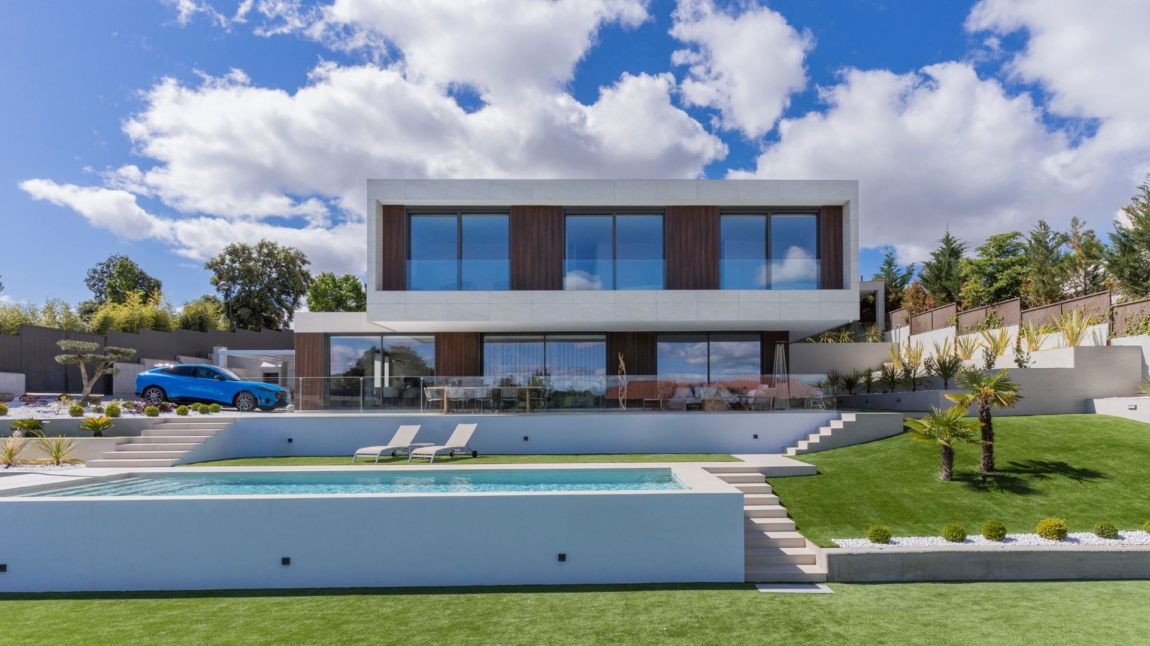
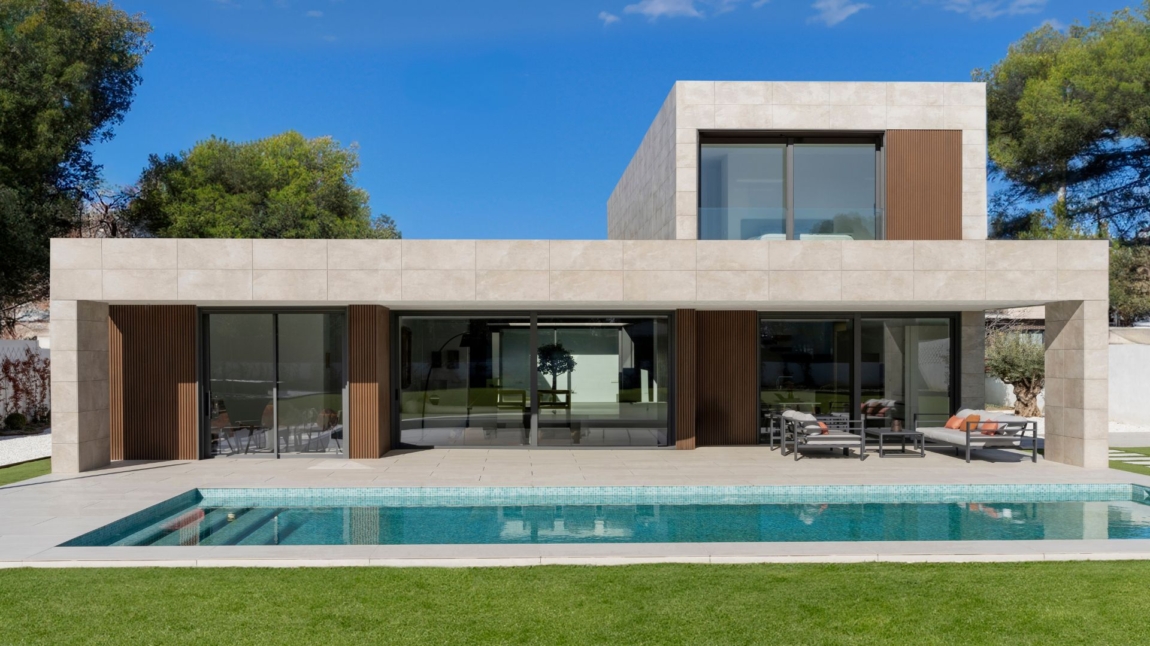

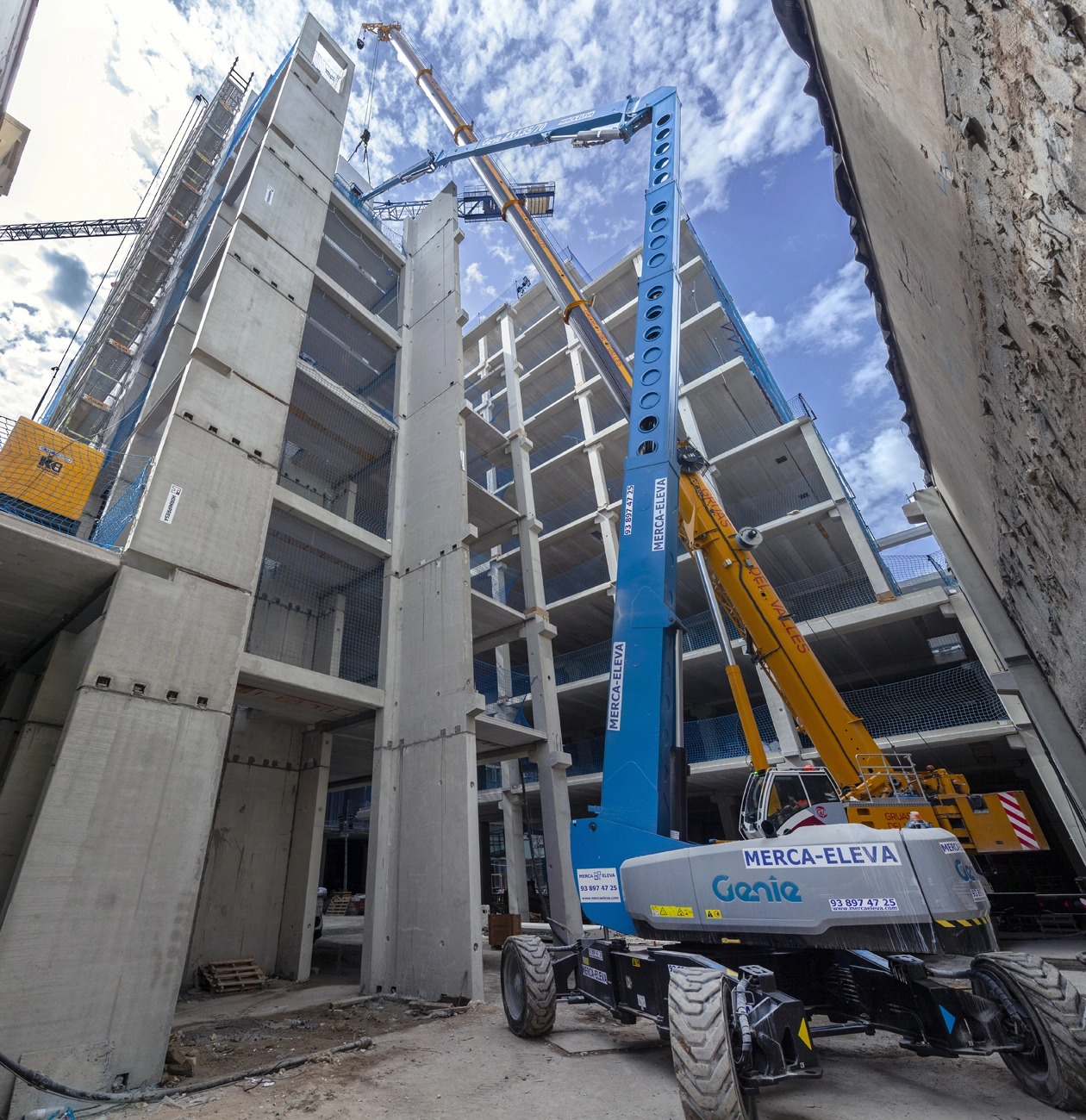
See all InHaus models → · See all Grupo Eurocasa models → · See all Hormipresa models →
What is a concrete prefab home?
A concrete prefab home is built from concrete panels or modules manufactured in a factory and assembled on the plot. Unlike traditional construction — where concrete is poured on-site into formwork — prefabrication allows tighter quality control, optimal curing, and more uniform finishes.
There are two main variants on the Spanish market:
- Large panels ("gran panel") — Complete wall panels (up to 12 m long) assembled on a conventional foundation. This is the system used by InHaus and Hormipresa.
- Three-dimensional modules — Fully finished concrete boxes (installations included) that stack or combine. Higher degree of prefabrication but less design flexibility.
Advantages of concrete prefab for homes in Spain
- Thermal mass and comfort in Mediterranean climates — Concrete absorbs heat during the day and releases it at night, smoothing out temperature swings. In areas with hot summers (Valencia, Andalucía, Murcia), this translates into real savings on cooling.
- Proven durability — Concrete is waterproof, fire-resistant (REI 120 or higher), and immune to wood-boring insects. With minimal maintenance, a concrete home can last 100 years or more.
- Seismic resistance — Concrete prefab panels meet seismic codes in Spain's highest-risk zones (south and southeast). It's the preferred system in municipalities across Murcia, Granada, and Almería.
- Competitive pricing in the standard segment — With Grupo Eurocasa from €80,000 or InHaus from €120,000, concrete is the most accessible system for 80–130 m² homes.
- A or A+ energy rating — Modern concrete prefab models include exterior insulation (SATE or internal lining) that reaches the A+ rating required under Spain's CTE DB-HE code.
- Easy to mortgage — Spanish banks readily accept CTE-certified concrete prefab homes. There's no ambiguity about the building's construction type.
Concrete prefab home prices (2025)
| Manufacturer | Model | Size | Price from | Timeline |
|---|---|---|---|---|
| Grupo Eurocasa | Classic 90 | 90 m² | €80,000 | 4 months |
| InHaus | S-80 | 80 m² | €120,000 | 5 months |
| Hormipresa | H-100 | 100 m² | €120,000 | 4 months |
| InHaus | M-120 | 120 m² | €185,000 | 5 months |
| InHaus | L-200 | 200 m² | €290,000 | 5 months |
All prices are turnkey and include fabrication, transport, and assembly. They don't include land, foundation, technical fees, or municipal taxes. Total cost (with land in a mid-tier area) usually runs 1.5 to 2 times the home price alone.
The price per built m² for concrete prefab (turnkey, excluding land) ranges from €900 to €1,500/m² in the standard segment. Premium reaches €1,500–€2,500/m². Equivalent-quality traditional construction costs €1,200–€2,000/m² with greater timeline uncertainty.
Where concrete performs best in Spain
Concrete isn't the right system everywhere, but it's the default choice across much of Spain for good reason:
- Mediterranean coast (Valencia, Alicante, Murcia, Andalucía) — Concrete's thermal mass is a genuine performance advantage here, not just a cost one. Homes stay cooler in summer with less mechanical cooling. See our Valencia-specific guide for regional pricing.
- Seismic zones (Granada, Almería, Murcia) — Concrete panel systems meet Spain's seismic design codes (NCSE-02) more straightforwardly than lighter systems, which need additional bracing in high-risk zones.
- Plots with difficult access — Large concrete panels require heavier transport and crane access, so very remote or steeply sloped plots can favour modular steel or timber instead.
- Northern Spain (Galicia, Asturias, Basque Country) — Timber systems are more traditional here and often outperform concrete on insulation-to-cost ratio in a cooler, wetter climate, though concrete remains viable.
Long-term maintenance and lifecycle costs
Purchase price is only part of the total cost of ownership. Concrete prefab homes have a distinct maintenance profile worth factoring in:
- Exterior finish: rendered or SATE-insulated facades typically need repainting or resealing every 10–15 years, at a cost of roughly €15–€25/m² of facade.
- Structural maintenance: essentially none for the concrete structure itself over a 50+ year horizon — no rot, no pest treatment, no re-coating of structural elements.
- Roof: flat concrete roofs with membrane waterproofing need membrane renewal every 20–25 years; pitched tile roofs common on concrete homes in Spain last 30–40 years with minimal upkeep.
- Insurance and resale: insurers and mortgage valuers in Spain are highly familiar with concrete construction, which tends to simplify both home insurance underwriting and resale valuations compared to less common systems.
Over a 30-year ownership horizon, concrete prefab homes typically have 20–30% lower cumulative maintenance costs than equivalent timber-frame homes in Spain's climate, largely due to the absence of wood treatment, pest control, and more frequent exterior refinishing.
Concrete vs timber vs steel: system comparison
| Criterion | Concrete | Timber / CLT | Steel |
|---|---|---|---|
| Entry price | Low | Medium (from €65,000) | Medium (from €75,000) |
| Thermal mass | High — ideal for hot climates | Low — needs more insulation | Low — thermal bridging |
| Fire resistance | REI 120+ | REI 60–90 (self-protecting CLT) | Needs added protection |
| Carbon footprint | High (cement production) | Negative (carbon capture) | Medium (recyclable steel) |
| Energy efficiency | A / A+ | A+ / Passivhaus | A / A+ |
| Maintenance | Minimal | Medium (wood protection) | Medium (anti-corrosion) |
| Design customisation | Medium | High | High |
Compare concrete models against other systems
Filter by construction system in the directory to see prices side by side.
See all models →Best concrete prefab home manufacturers in Spain
- InHaus (Valencia) — The market leader. Over 111 models from €120,000. Proprietary large-panel system, A+ rating across all models, nationwide delivery. Average timeline of 5 months.
- Grupo Eurocasa (Burgos) — Over 10,000 homes delivered. The most affordable option in the standard segment, from €80,000. Fixed price guaranteed, nationwide delivery in 4 months.
- Hormipresa (Castilla y León) — Specialists in high-durability industrial concrete. Their H-100 and H-180 models stand out for structural resistance. Good fit for areas with high thermal swings.
- La Fábrica de Casas — The most affordable model on the market (Mini 30, from €29,900). CTE compliant. Ideal for a small first home or rural plot.
- Casas Modulares España (Madrid) — Modular concrete with the fastest turnaround on the market: 2.5 months. From €50,000. Good value in the mid segment.
When comparing quotes from different concrete manufacturers, make sure each one covers the same scope: fabrication, transport, assembly, installations (electrical, plumbing, drainage), and interior finishes. Price differences between offers usually come down to differing scope of work, not differing construction quality.
Paperwork for a concrete prefab home
The process is identical to that of any new build in Spain:
- Land verification — The plot must be classified as urban or developable. The manufacturer can advise, but verification is the buyer's responsibility.
- Geotechnical survey — Mandatory for foundation design. Indicative cost: €600–€1,500.
- Architectural project — Drafted by the manufacturer's architect or an independent one. Includes report, drawings, and detailed budget.
- Major works permit — Timeline: 2–6 months depending on the municipality. Cost: 2–4% of the works budget in fees and taxes (ICIO).
- 10-year structural insurance ("seguro decenal") — Mandatory for all new homes. Covers structural defects for 10 years. Cost: 0.5–1% of the works budget.
- Land registry inscription — Required for mortgage and future sale. Done once the first-occupancy licence is granted.
Large panel vs 3D module: which to choose
Buyers comparing quotes often don't realise they're comparing two structurally different approaches. Understanding the trade-off helps explain why prices and delivery windows vary between manufacturers:
- Large panel systems (InHaus, Hormipresa) — Wall and floor panels are cast flat in the factory, then transported and erected on-site over a conventional foundation, similar in principle to how the structure is assembled but with far tighter tolerances than pouring concrete on-site. This approach offers more layout flexibility since panels combine like building blocks.
- 3D modular systems — Complete room-sized boxes, including internal finishes, wiring, and plumbing, are built and largely finished inside the factory, then craned into position and joined together on-site. This reduces on-site labour dramatically and shortens weather-exposure risk, but transport logistics are more demanding (wide-load permits, crane access) and design flexibility is lower once a module size is fixed.
For most single-family homes in Spain, large panel systems remain more common because they allow more architectural customisation at a lower transport cost. 3D modules tend to suit projects prioritising speed above all else, or sites with very tight construction windows.
What to check before signing a contract
Beyond price, a few technical checks separate a reliable concrete prefab manufacturer from a risky one:
- AENOR or equivalent factory certification — Confirms the factory's quality control process is independently audited, not just self-declared.
- Reinforcement specification — Ask for the steel reinforcement diameter and spacing used in load-bearing panels; reputable manufacturers provide this without hesitation.
- Insulation continuity — Verify whether the insulation system (SATE or internal lining) is continuous across panel joints, since thermal bridging at joints is one of the most common sources of underperformance versus the advertised energy rating.
- Reference sites — Ask to visit a completed home of the same model, ideally one that's been occupied for at least a year, to assess how the finish has aged.
- Payment schedule tied to milestones — A trustworthy manufacturer stages payments against verifiable progress (contract, factory completion, delivery, handover) rather than requesting a large upfront deposit with little accountability.
Be cautious of any concrete prefab manufacturer unwilling to share their AENOR certification, structural calculations, or a reference site to visit. Spain's concrete prefab sector is mature and well-regulated — reputable manufacturers treat these requests as routine.
Frequently asked questions
A 100 m² turnkey concrete prefab home costs between €100,000 and €200,000 depending on finish level. Standard models fall between €120,000 and €160,000. Land, foundation, and technical fees are additional.
Not necessarily. In the standard segment, concrete prefab is often cheaper than high-end CLT or timber frame. Long-term maintenance is also lower than timber. Premium CLT systems are more energy-efficient but significantly more expensive.
The total timeline from contract signature to delivery is 4–6 months for most Spanish manufacturers. Factory fabrication takes 6–10 weeks. On-site assembly takes 1–3 weeks. Permit processing runs in parallel.
Yes, provided they comply with the CTE and are registered as real estate. InHaus, Grupo Eurocasa, and Hormipresa models are CTE-compliant and mortgage without issue. A self-build mortgage is the standard financing product.
In traditional construction, concrete is poured on-site into formwork. In prefab, panels are manufactured in a factory under controlled conditions, guaranteeing greater uniformity, shorter build time, and better finish. Structural strength is comparable or superior in the prefab version.
Explore all concrete prefab models
Full directory with real prices, delivery timelines, and technical specifications.
Browse the directory →